Waste products
Waste substances
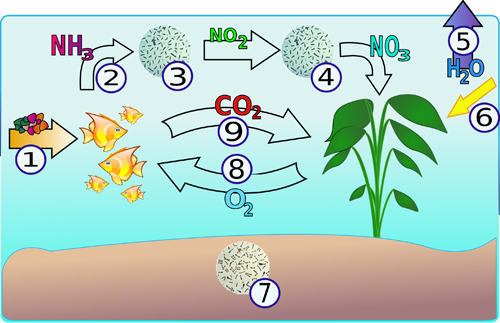
Image from Wikimedia Commons
Degradation
The first waste substance that appears in the aquarium is ammonia. This is highly toxic and in small concentrations can kill all the fish. Fortunately, the ammonia in the aquarium is quickly converted to ammonium if the pH is below 7.
If the pH rises above 7 again, the ammonium is transformed back into ammonia. This may explain some cases where a delayed water change causes sudden "inexplicable" fish deaths.
In a healthy aquarium with a mature filter, the ammonia level is so low that it is not measurable with normal tests. If oxygen is present in the filter and in the substrate, ammonium and ammonia are converted to nitrite, which is less toxic than ammonium. The nitrite is not affected by pH.
Over time, the nitrite is broken down to nitrate, which is even less toxic. The nitrate is not further broken down, and must normally be removed from the aquarium when changing the water. You can also rely on anaerobic filtration to break the nitrate down further, but this is both complicated and risky.
Plants also absorb some nitrate, but in order to achieve a balance between nitrate production and uptake, you must in practice have an aquarium of many hundreds of litres, full of plants and with good light. And no more than a couple or three small fish. Few aquarists are interested in such a set-up.
If the bacteria in the filter and/or substrate are left without oxygen, things can start to go the other way. The beneficial bacteria die in droves and release waste substances that kill the fish.