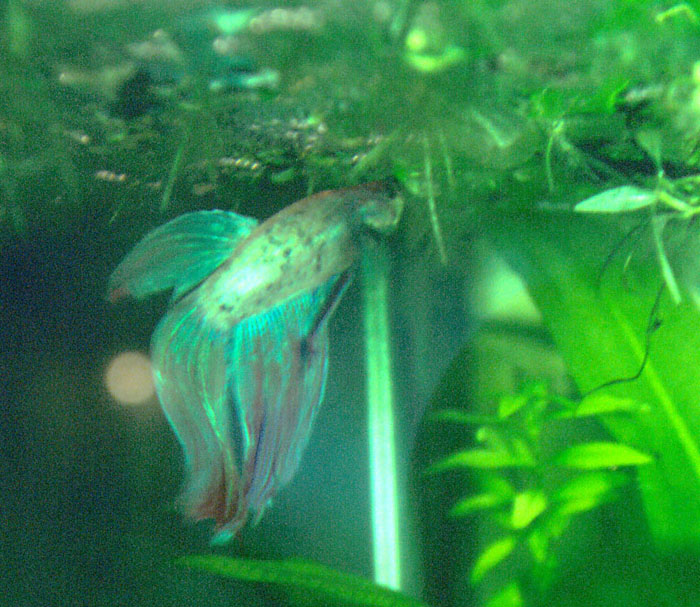
Siamese fighting fish – Betta splendens
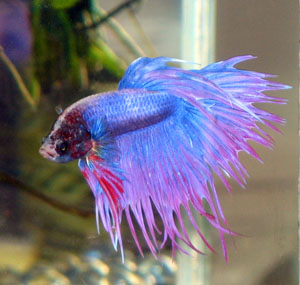
Image from Wikimedia Commons
Siamese fighting fish Betta splendens
As you know, bettas do not live in aquariums in the wild, and the best thing to do is to imitate nature as best you can. Wild Siamese fighting fish are mostly found in shallow ponds and rice paddies in Southeast Asia, specifically Thailand, Malaya, Cochin-China and Vietnam.
Specimens in captivity can be up to 10 cm long, but about 6.5 cm is the most common maximum length. In the wild, 5 cm is the usual length for grown individuals.
A Siamese fighting fish rarely gets older than three or four years in an aquarium, and almost never in the wild. In captivity they can live longer (more than four years), but this depends on factors such as water quality, temperature, food and life history.
The best age for breeding is approximately between 5 and 15 months.
Like all fish, the betta has specific water requirements. It is not true that they "tolerate everything". If a betta has lived in poor conditions, this can weaken its immune system for a long time afterwards.
The bettas we see in aquariums usually differ from wild bettas in that, after many years of targeted breeding, they have acquired more and stronger colours, as well as larger and more varied fins.
Wild male bettas have short fins, almost like the female fish we are used to from the aquarium shops. They are usually brownish with faint red and/or blue color on the fins and body. The colors only become clear when the fish show themselves to each other.
The males also naturally have larger fins than the females, but not as extreme as the captive-bred varieties.
- Norwegian names: Kampfisk, siamesisk kampfisk, slørkampfisk.
- English names: Betta, betta, Siamese fighting fish
- Scientific name: Betta splendens, see taxonomy.
- Thai names: Pla Kat Thai, Plakat; see the glossary.
.jpg)
Picture from Wikimedia Commons
Variants
In the wild, the betta is brownish with red and blue parts. The male fish have stronger colors than the females.
In pet shops you will find many varieties that have been bred in captivity. The vast majority of the fish that you can buy in the shop have longer fins and stronger or completely different colors than the fish in the wild.
The first fin variation to be bred was the veiltail (veil-tail, VT). Unlike the natural tail fin of the betta, (round-tail), the veil is long and hangs down. This variant has traditionally been dominant in Norwegian aquarium shops, but this is slowly but surely changing. This is because newer and popular fin variations have become available. Examples of these are crowntail (CT), delta (DT) and halfmoon delta (HM).
Many breeders have now switched to only breeding with these tail shapes. I imagine that breeding VT will eventually become a niche, as the other varieties take over more of the market. This may take a while, as the VT genes are both widespread and dominant.
Price
A male betta usually costs between €4 and €8 in an aquarium shop, with females costing about half as much. Good breeding stock can easily fetch €20-30. One of the more expensive bettas I've heard of was a red-and-white butterfly halfmoon male that sold for about €200. It is certainly possible to find even more expensive bettas if that is what you are interested in.
If you are looking for a special fish, for example for breeding, you should contact a breeder in Norway or abroad. Pet shops mostly carry lower-grade fish, while breeders keep the best fish themselves. Good quality fish are sold over the Internet or exchanged for other fish.
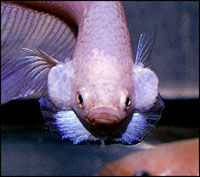
Picture from Wikimedia Commons
Territory
The betta establishes a territory around its bubble nest and vigorously defends it against intruders, especially other bettas.
In nature, the territory of the male betta is between one and three meters in diameter. Neighbouring bettas are tolerated, but usually do not enter the area. Unknown bettas that appear to be strays looking for a free place are chased away, often in cooperation with the neighbour. This shows that the betta is able to distinguish between individuals.
A female will be better received, provided the male has no eggs or fry to look after and she is willing to spawn.
In an aquarium, the situation is slightly different. Few aquariums are large enough to accommodate more than one betta within its territory. I have never heard of anyone successfully keeping two adult males peacefully in the same tank, regardless of the size of the tank (except males that have grown up together).
The female fish also forms a territory that is somewhat smaller than the male's.
Escape hazard
The ability to breathe air makes the betta exceptionally adept at moving across land. As long as it does not dry out, it can stay out of the water for a long time. It is therefore a good idea to cover the aquarium, or ensure that it has high edges, so that the betta does not jump out. The females are particularly skilled (and willing) to escape.