Cycling
Image from Wikimedia Commons
Startup
When all the bacterial cultures are in balance in the aquarium, the aquarium has a life of its own that you don't see at first glance. The necessary decomposition of waste products does not start immediately when you pour water into a tank. In theory, a newly started aquarium takes around five weeks to mature.
What comes out of the fish and from rotting feed residues is ammonia and ammonium. These substances are broken down by bacteria to nitrite, which in turn is broken down to nitrate by another type of bacteria.
When starting an aquarium, the first fish will produce ammonia which, due to a lack of bacteria, is not broken down. The ammonia therefore accumulates in the water. After about ten days, the bacteria that process it begin to establish themselves. The ammonia stops accumulating, and begins to be converted into less toxic nitrite.
Now the nitrite accumulates in the aquarium. It still takes about 20 days before the bacteria that break down nitrite are established. The nitrite is then broken down into almost harmless nitrate.
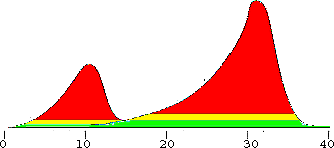
This means that any newly started aquarium will go through two crises in the first month; An ammonia/ammonium peak after approx. 10 days, and a nitrite peak around a month after starting. Both of these peaks can kill the fish if precautions are not taken.
The graph shows typical effects on ammonia/ammonium and nitrite in a start-up cycle. The numbers on the X-axis correspond to the number of days, and the colors indicate which levels are favorable for fish.
If you disturb the biological balance in a mature aquarium, for example by cleaning the filter in chlorinated tap water or giving the fish bactericidal drugs, you risk killing so many bacteria that you send the aquarium into a new cycle that also takes about a month. With a bit of luck, not all the bacteria will die, and you can get a slightly smaller effect of the toxins, and a shorter recovery time before the bacterial culture recovers.
The 36-day cycling period can be shortened by adding beneficial bacteria. This can be achieved with products you buy in the aquarium shop (it is debated whether these work at all), or by adding matured filter material or gravel from another aquarium.
To get any effect from this, you have to add new bacteria several times at intervals of a few days. This is because the nitrite bacteria cannot tolerate high ammonia levels, and thus cannot establish themselves until the ammonia bacteria are well established. The ammonia bacteria, on the other hand, must take in large amounts of ammonia before they divide, and cell division takes up to several days. They also need darkness.
Popular Methods
Fishless cycling
Many people swear by fishless cycling. Then you set up the aquarium with filter, gravel and plants, and leave it like that for the necessary time. All tap water has some ammonia and nitrite in it, and in many cases this is enough to start the filter.
Nevertheless, there are many who feed the "invisible fish" lightly a couple of times during the period, to be sure that the filter has enough to work with. A solution of ammonium chloride (also known as sal ammoniac or salmiac) is available in concentrations of 5–10%. A small amount (approximately 1 ml of ammonium chloride solution per 100 litres of water) should be enough to get the filter started. Be sure to measure the water parameters; if you overdo the ammonia addition, that's not good either for the filter bacteria.
Fish-in cycling
This is a method recommended in many aquarium shops and old manuals. An eager beginner may find this method easier to accept, since after all you are "allowed" to buy some fish at once. Many believe, however, that this is cruel to the first fish, because the nitrite and ammonia levels will be higher than is beneficial for them.
If you're going to start with a few fish, make sure it's really few fish. During the first month, you should change the water several times a week, and you should not be too surprised if disease breaks out in the aquarium.
Seeding with filter media
If you already have an aquarium, you can get started with a new one much faster. Set up the aquarium with gravel, plants, a filter and so on. Let it stand for a day so that the chlorine can dissipate. Then turn off the light and transfer a generous amount of mulm from the mature filter in your old aquarium to the new one. The helpful bacteria in the sludge will settle in the new filter and establish it within a relatively short time.
With this method, it is reasonably safe to start with a few fish, but you should still keep an eye on the water parameters. Feel free to transfer the filter sludge three or four times during the first couple of weeks.
Bottled starter culture
You can buy liquid products to start the filter. These contain live Nitrosomonas bacteria, which convert ammonia to nitrite, and Nitrospira, which convert nitrite to nitrate. It was once thought that Nitrobacter performed the latter step; this is only partly true, yet many products still contain Nitrobacter instead of Nitrospira.
Note that these products are not the same as common water improvers (AquaSafe etc.) which are intended for aquariums where the filter is already running.
Follow the instructions for use, make sure to store the bottle correctly, and measure the water parameters regularly.
Opinions are divided as to whether these products are particularly effective.
Starting without cycling
This is not a method as such; I just want to describe a very common (and bad) way to start an aquarium: Fill the aquarium with plants, water, a filter and a heater, and put the fish in as soon as the water reaches the right temperature. This is how many beginners do it, and many soon give up the hobby because of it.
When the fish get sick and die (which usually happens after about 14 days, or after two or three weeks; see the graph), you tend to lose the joy of the hobby, and then you start playing e.g. bridge instead. Not a bad word about bridge, but if that's your plan, you're reading the wrong website. ;)
This is a trap that you should be well prepared not to fall into after reading this.
Combinations
The most straightforward is often a combination of the different methods mentioned above. For example, you can start with an empty aquarium, kick-start it with a solid dose of filter sludge, wait a week, put in a few fish, add more sludge and proceed slowly and carefully from there.
Always keep a close eye on the fish during the start-up period, and measure the water as soon as you suspect that something might be wrong.