Treatment

Picture from Wikimedia Commons
Treatment should take place according to the manufacturer's instructions for the medicine you are using. In some cases, it may be advantageous to combine the medicine with salt and/or increased temperature.
Ordinary table salt can be used, but it is safest to avoid salt containing anti-caking agents and iodine. You can also buy special salt for treating fish in the pet shop. This powder consists of several different salts, and has, among other things, the advantage that it releases oxygen in the water for a while after it is added to the aquarium.
Any activated carbon in the filter must be removed, so that it does not absorb the medicine.
It is often best to isolate the sick fish in a small aquarium or bucket.
Decorations are not necessary, but can hide the fish and make it easier for them to de-stress. A dark bottom can make the fish feel safer. Floating plants can have the same calming effect on betta and other surface fish. It is often best to dim the light; diurnal fish become calmer then.
If you medicate in the main aquarium, remember that antimicrobial medicines can kill the bacterial cultures in the filter and substrate.
Convalescence
Naturally enough, fish should be allowed to be in a low-stress environment after treatment. Weakened fish easily become victims of bullying in a community aquarium.
How long the fish takes to recover will depend on the disease in question, how badly the fish was attacked, and several other factors such as temperature. Make sure to give the fish a varied and nutritious diet, but not overfeed. It may take a little while for the appetite to return fully.
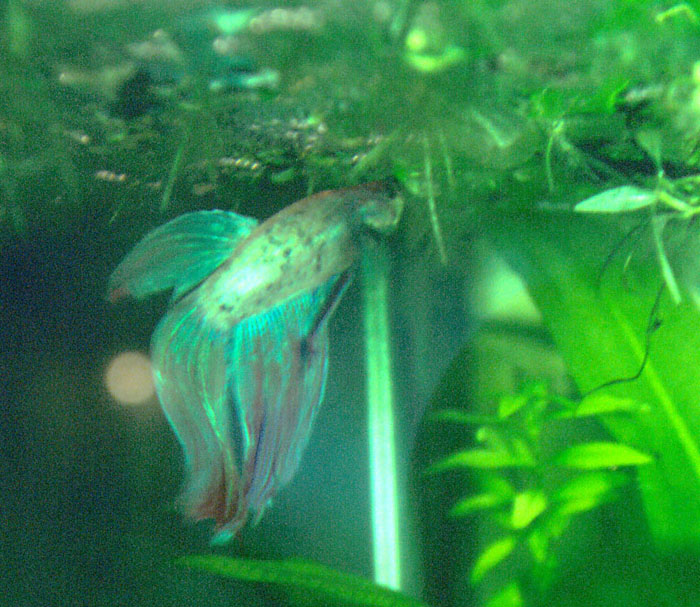
Many Bettas have large and exposed fins. These can easily be damaged by nipping or diseases. They usually grow back once the fish recovers. How long this takes depends on the aquarium temperature, the fish's age, and how well it is fed. If the fins are almost gone, you can expect at least 2-3 months of convalescence in most cases. If the fish is old, the fin tissue may be in a worse condition. The fins do not necessarily have time to become perfectly fine during the fish's lifetime.
Picture from Wikimedia Commons
Quarantine
It may be a good idea to keep newly acquired creatures in quarantine for two to three weeks before introducing them to the aquarium. This can prevent parasites etc. from invading the aquarium.
Examples of life forms that can ruin the whole aquarium hobby for you include:
- Ichthyophthirius multifiliis ( white spot parasite),
- Lepeophtheirus salmonis (salmon lice),
- Gyrodactylus salaris (the salmon parasite that has destroyed many Norwegian salmon rivers),
- protozoan parasites,
- brush algae,
- herbivorous snails,
- the floating plant Elodea.
Humane euthanasia
Sometimes medicating a sick fish is no longer worthwhile. If the fish is too weak or old, it will not be able to survive. Then it may be better to kill the fish in a humane way.
Boiling water should only be used as a killing method for very small fish. The quickest method is to place the betta on a cutting board and cut the head off with a sharp kitchen knife.
Never throw a live fish into the toilet, however sick it may be. Dead fish should also be thrown in the bin instead of the toilet.