Fry
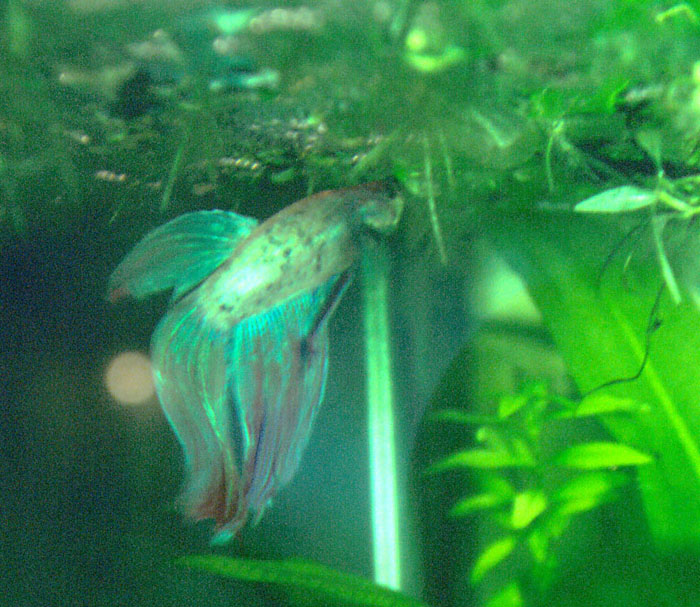
In the wild, the male betta has a territory of 1-3 meters in diameter, most often in a shallow puddle or in a rice field. Here he builds a bubble nest. Females are not as territorial, but roam more. When a female finds a male's territory, and the male finds her, he lures her to the nest.
There the mating ritual begins: The male "embraces" the female with his body, so it looks as if he is squeezing the eggs out of her. There are usually 1-10 eggs at a time. He fertilizes the eggs immediately, and carries them up into the nest. The female is temporarily stunned by the embrace and appears lifeless as she sinks towards the bottom. (Some females are not paralyzed, but instead help the male along to pick up eggs.) After a few seconds, she perks up again, and they repeat the process until she runs out of eggs.
Then he chases her away and spends the following period looking after the nest, the eggs and, eventually, the young.
Picture from Wikimedia Commons
Eggs
Betta eggs are white or yellowish. They are usually easy to spot in the bubble nest, unless the male has hidden all the eggs beneath a leaf or something similar.
Seeing the difference between the sexes
In young fish (under 3-4 months) it can be very difficult to tell the difference between the sexes. Even professional breeders make mistakes all the time. It may therefore be wise to avoid the youngest bettas in the aquarium shop, where it is most difficult to identify gender by looking at body shape and fins.
The surest sign you can look for if you are wondering about the sex of a young fish is a white dot that females have under their bellies. The dot is located directly in front of the anal fin. This is the opening of the oviduct, which males naturally do not have.
Otherwise, you have to look at the fins. The first difference you can see is often that the rear end of the anal fin is more pointed in the males, but this is not entirely certain either.
Females have a thicker belly, and this develops quite early. If you look at the body shape, preferably from above, you quickly learn to see the difference between fairly young fish.
If you have spent some time studying the betta, their behaviour can also provide useful clues. It takes a little while to learn, but you eventually develop a feel for whether the fish in front of you is male or female.
To summarise: No method is certain. The oviduct under the abdomen of females is the surest (and earliest) sign. If it is absent, the fish may be male or simply very young. Beyond these signs, you simply have to train your eye.
Feed
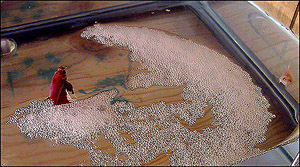
Picture from Wikimedia Commons
Fry, of course, have slightly different requirements from adult fish. Firstly, the fry have much smaller mouths, so the feed must be sized according to the size of the fry. Secondly, the fry make high demands on nutritional content, as they eat and grow a lot. Therefore, live food is best in the beginning. With live feed, many more of the fry will grow up.
They also have small stomachs, and need feed much more often than adult fish. While the adults can go for up to two weeks without food, and should not get more than they can eat in a few minutes, fry must be fed almost continuously, and should get as much as they can ingest.
Disease
The most difficult part of breeding is not getting the parents to spawn, but getting the young to grow up. Some always die because of genetic defects, developmental problems, unstable water parameters, illness, accidents and coincidences. Here, two laws apply; Murphy's and Darwin's.
The young need a lot more space as they grow, otherwise many will stop growing or die. In this sense, it is "useful" that some fry are weaker than others.
If you get fry with defects, such as missing body parts or crooked spines, they should be euthanized as soon as possible to save the sick fish from unnecessary suffering and to provide better conditions for the others. This can be done quickly and efficiently by giving the defective fry as feed to larger fry or fish.