Taxonomy

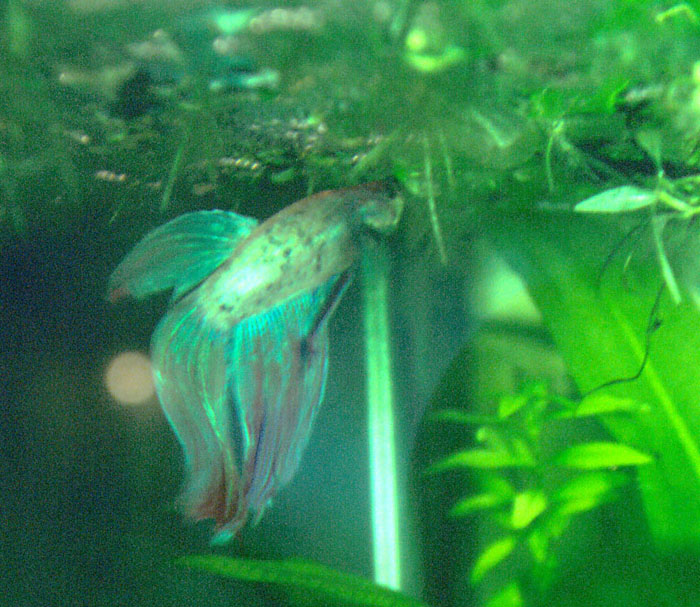
Picture from Wikimedia Commons
Systematics
- Siamese fighting fish (
Betta splendens,
Regan
(wp)
, 1910)
is therefore the fish that this page is about.
Other scientific names for Siamese fighting fish (used synonymously in the literature): Betta trifasciata, Betta pugnax, Betta rubra, Macropodus pugnax. - Betta ( Betta, Bleeker (wp) , 1850), is a genus with both mouthbrooding and bubble-nesting species. Not all species are equally aggressive, and many are kept in an aquarium.
- Macropodusinae (Hoedeman, 1948) is the betta's correct group, although it is often described as Anabantidae or Belontiidae.
- Gouramis (wp) (Osphronemidae, Bleeker, 1859) is a large group of labyrinth fishes. Many are popular aquarium fish.
- Labyrinth fish (wp) (Anabantoidei) consists of over 80 species distributed among the four families Anabantidae, Belontiidae, Helostomatidae and Osphronemidae. The species in this group have the ability to breathe air using an organ in the head called the labyrinth.
- Spiny-finned fish (wp) (Perciformes) consists of 19 suborders and over 9,000 species, mostly predatory fish in shallow water. They lack adipose fins. The pelvic fins have one spine and five soft rays, and sit far forward. The pectoral fins are on the sides.
- Spiny-finned fish (wp) (Acanthopterygii) consists of approx. 40% of all fish species.
- True bony fish (wp) (Teleostei) is a group with over 26,000 species.
- Ray-finned fish (wp) (Actinopterygii) includes, among other things, sturgeons (Chondrostei) with 25-30 species, bichirs (Polypteridae) and the bowfin ( Amia calva).
- Jawed vertebrates (wp) (Gnathostomata) contains all vertebrates except hagfish and lampreys, so one could say that the family tree of the betta meets that of humans at about this point. The group originated in fresh or brackish water 440 million years ago.
- Chordates (wp) (Vertebrata, Cuvier (wp) , 1812) make up over 50,000 species.
- Vertebrates (wp) (Chordata, Bateson (wp) , 1885) is characterized by having an elastic support rod called the dorsal string.
- Deuterostomes (wp) (Deuterostomia) are so advanced that we eat and defecate through two different holes, and make up five percent of all known animal species.
- Bilaterians (wp) (Bilateria) are bilaterally symmetrical animals. Starfish, sea urchins and jellyfish are among the few groups that do not belong here.
- Animals (wp) (Metazoa) all have common ancestors who lived approx. one billion years ago.
- Opisthokonta (wp) are animals, fungi, as well as some organisms that were previously named protoctists (wp) .
- Eukaryotes (wp) (Eukaryota) are unicellular or multicellular organisms with an arsenal of useful cell organelles.
- Life (wp) includes most things that move, plus quite a few organisms that barely do.
Betta sp.
The abbreviation sp. is an abbreviation for species. Betta sp. therefore means an unspecified, unknown or undescribed species in the genus Betta. It identifies the fish as a Betta without claiming to know which species it is; the species may not yet have been formally named.
If you know that you mean the Siamese fighting fish, write Betta splendens.
If you do not know whether it is a Siamese fighting fish or another Betta species, write Betta sp. But then you have to make sure that no one misunderstands and thinks that you mean Betta splendens ...