Common diseases in aquarium fish
Picture from Wikimedia Commons
Bacterial fin rot
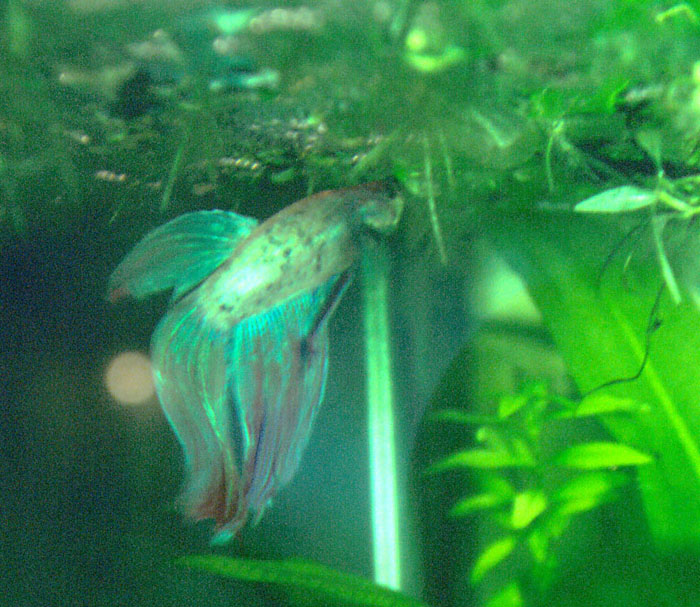
Male bettas are particularly prone to this because of their long fins. Fin rot can be caused by poor water quality or otherwise reduced general condition of the fish. The fins rot and disintegrate, becoming jagged at the edges and discoloured. Often followed by a fungus attack. Fin rot is treated with salt, antibacterial agents, and in extreme cases antibiotics.
Fungal disease
Bettas are vulnerable to fungi. Saprolegnia and Achlya are among the fungal genera that can attack fish. Fungal attacks can be triggered by rapid or large temperature fluctuations, or if the fish is exposed to infected mosquito larvae or uneaten feed that nourishes a fungal culture. They can also be triggered by a weakened condition due to poor water quality, injuries or illness.
The infection looks like white “mould” and often appears near the mouth, gills or in wounds, such as on the fins after fin rot. It is treated with salt and suitable antifungal medicines.
Columnaris - ("mushroom" or "mouth fungus")
A common fish disease that can easily be confused with fungus is columnaris. This disease is caused by the bacterium Flavobacterium columnare (also known as Flexibacter columnaris). Many “fungal medicines” for aquarium fish are actually designed to fight columnaris, since it is common and so often confused with fungus. While fungi produce a “hazy” white coating, columnaris looks more like white “warts” on the fish, especially on the lips (where it is then mistakenly called “mouth fungus”), the head or the back.
Dropsy (also called dropsy or Malawi bloat)
The abdomen becomes swollen, often so much that the scales on the sides of the abdomen become clearly visible. The eyes may also begin to bulge. (N.B. many betta have slightly protruding eyes by nature). The fish has a characteristic body shape that is easiest to recognize from above.
This is not really a disease, but a symptom that can indicate all kinds of internal infections. Most common in cichlids, carp and labyrinth fish. Female bettas are prone to dropsy after laying eggs. It can be contagious, but is not always so.
There are three main causes of dropsy in aquarium fish: Overconsumption of salt, prolonged stay in bad water, or wrong diet that has caused parasite infections. Other causes can be poisoning, internal injuries and cancer.
Dropsy is feared by aquarists because the fish usually cannot be saved once the symptoms are obvious. In some cases it can be treated with a strong salt treatment and possibly antibiotics. The most important, and most difficult, thing in the treatment of dropsy is to detect the disease in time.
Some aquarists distinguish between two forms of dropsy: one caused by an infection of the kidney or liver, and one involving a general accumulation of fluid in the abdomen.
White spot disease (also called ich; scientific name: Ichthyophthirius multifiliis)
The fish becomes frenetic in its movements, and can look like a pennant in a stiff gale when it swims. After two or three days, you can see lots of small, white dots on the fish. These are small parasites, which can spread quickly from fish to fish. They attack skin and gills.
It can be treated with diluted formaldehyde (HCHO), malachite green or methylene blue. Many products against white spot are sold in aquarium stores. Because the parasites are temporarily resistant to medication during parts of their life cycle, treatment should continue for several days.
White spot is a good reason not to take wild fish or other animals directly from nature into the aquarium without long quarantine time.
Velvet disease - (English: velvet, Latin: Oodinium or Piscinoodinium)
It looks like fine golden-grey to white dust on the fish. The fish can also become very short of breath. The fish often loses its appetite and becomes lethargic.
Caused by the parasite Oodinium pillularis. It can be triggered by ammonia/ammonium and nitrite, or by excessively high nitrate values.
There are medicines for this on the market. Treatment should be started as early as possible, before internal organs are attacked.